
Oil and natural gas prices markets are showing early signs of volatility as we head into 2026. While the latest EIA report paints a bearish picture, several key factors—including OPEC+ policies, geopolitical tensions, and strong Asian demand—are preventing a freefall. Investors and traders are now closely watching crude oil and natural gas price movements as we enter the new year.
In this comprehensive analysis, we’ll cover:
- How the EIA inventory report affects oil and gas prices
- Technical charts and trends for WTI and Brent crude
- Natural gas futures outlook and key support/resistance levels
- Macro and geopolitical factors influencing the market
- Strategies traders can use to navigate volatility
EIA Report Sends Shockwaves Through Oil Markets
The Energy Information Administration (EIA) report released at the end of December took the markets by surprise. Gasoline inventories surged by 5.8 million barrels, while distillate inventories rose 5.0 million barrels, signaling an unexpected oversupply.
Such a sharp rise in crude and refined product stocks usually triggers downward pressure on prices, as traders fear excess supply. However, the actual price movement has been muted, reflecting a delicate balance between oversupply and other bullish factors in the market.
READ ALSO:GBP/USD Forecast for 2026: Central Bank Divergence, Volatility, and Crucial Price Levels
The Role of the US Dollar
A strengthening US dollar has added pressure on commodities, including oil and natural gas. Typically, a stronger dollar makes crude more expensive for holders of other currencies, reducing demand and putting downward pressure on prices.
Despite this, prices have not collapsed. Analysts attribute this resilience to:
- OPEC+ supply discipline
- Strong demand from China and other Asian economies
- Geopolitical uncertainties
OPEC+ Holds the Key
One of the key reasons oil prices have remained relatively stable is the expectation that OPEC+ will limit production increases into early 2026. This policy prevents further oversupply from pushing prices lower, even as the IEA warns of a global crude surplus of 4 million barrels per day next year.
If OPEC+ keeps output in check, it could act as a price floor, maintaining crude near current levels despite bearish inventory reports.
READ ALSO: MCX Gold Support & Resistance Today | Live Price & Trend Analysis
Asian Demand: China Leading the Way
Demand from Asia, particularly China, is supporting the market. China’s oil imports climbed 10% last month to 12.2 million barrels per day, highlighting strong industrial activity and energy consumption.
This robust demand has offset bearish inventory signals, keeping oil and natural gas prices reasonably stable amid volatility. Traders and investors are closely monitoring whether this trend continues into 2026, as any slowdown in Chinese imports could put further pressure on prices.
Natural Gas Futures Outlook
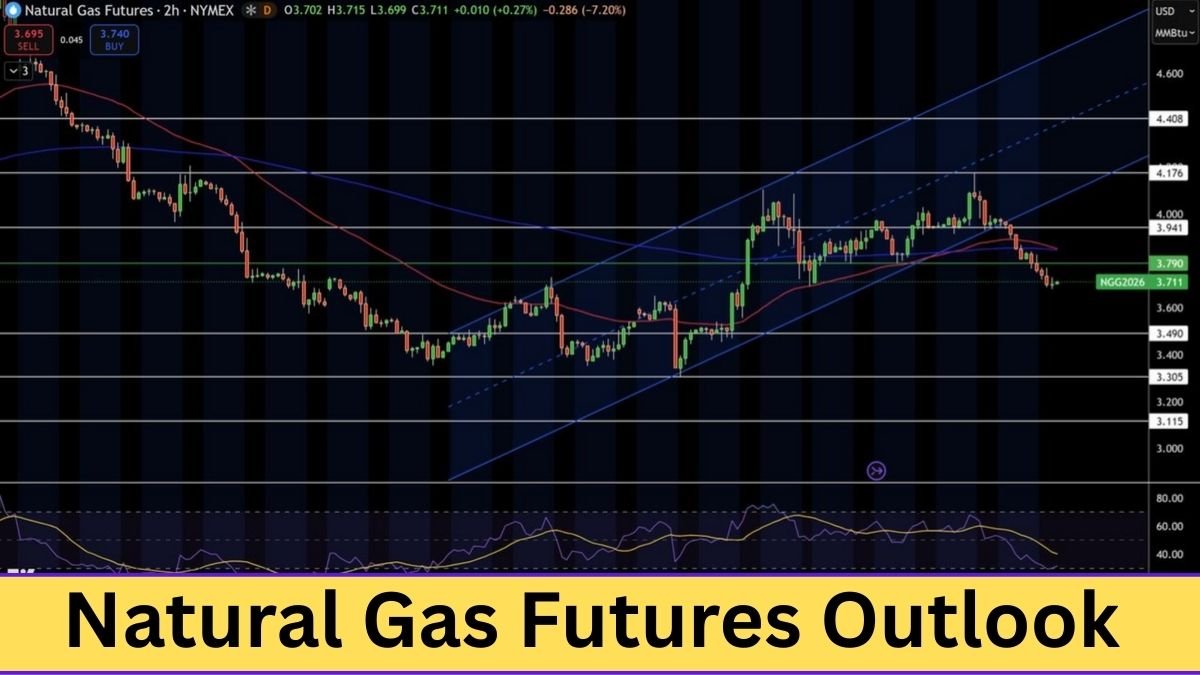
Natural gas futures closed near $3.71 at the end of December, maintaining levels seen on December 31st. On the 2-hour chart, prices have slipped slightly under the rising trend channel midline after briefly testing $4.05.
Technical indicators for natural gas:
- 50-Day EMA: Fell to $3.85, signaling short-term weakness
- 200-Day EMA: Around $4.17, acting as a ceiling
- RSI: Dropped to 38, showing bearish momentum
- Support Levels: $3.65 and $3.50
- Resistance Levels: $3.95
Short-term traders should watch the $3.65 support for potential reversals, while a break above $3.95 could trigger a short-term rally.
READ ALSO: MCX Silver Today Support & Resistance |Intraday Trend Analysis
WTI Crude Oil Technical Analysis
WTI crude remains around $57.40, reflecting a holiday pause with markets closed for the New Year. The 2-hour chart shows a symmetrical triangle, formed by a falling upper trendline and a rising support line since mid-December.
Key technical insights:
- RSI: Neutral, sitting in the middle
- Support Levels: $57.00, $56.20
- Resistance Levels: $58.20, $59.60
Trading strategy: A confirmed break above $58.20 could open the door to $59.60, while a stop-loss below $57.40 would mitigate risk.
Brent Crude Outlook
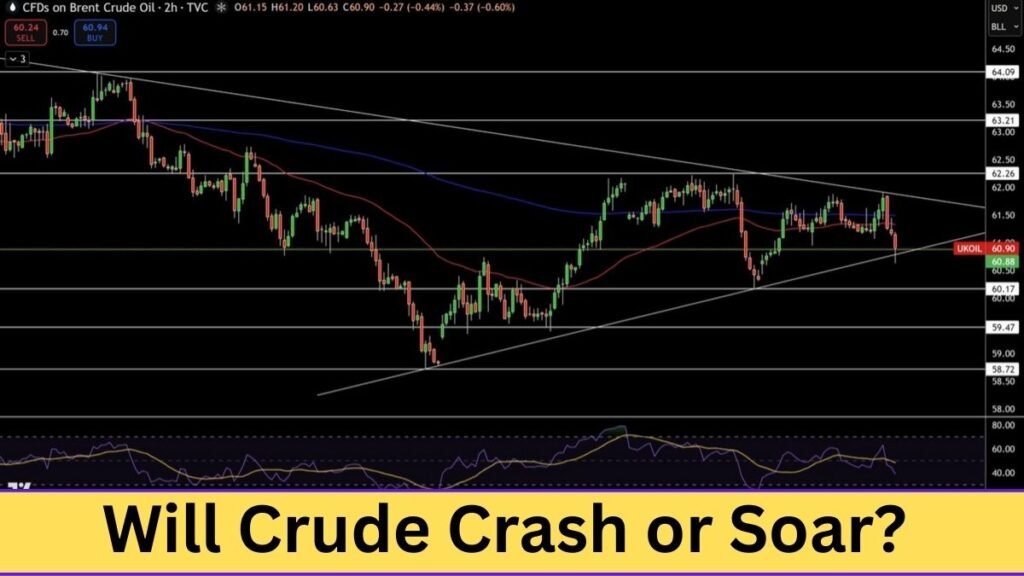
Brent crude closed near $60.90, with the 50-period EMA around $61 and the 200-period EMA at $62.30, capping upside momentum. The RSI of 45 indicates neutral momentum, with key levels as follows:
- Support: $60.20, $59.50
- Resistance: $61.80, $62.30
A break above $61.80 could target $63.20, while a fall below $60.20 may trigger a short-term decline. Traders should watch these levels closely in early 2026.
Geopolitical Tensions Keep Prices Supported
Even with bearish fundamentals from inventory data, crude prices are cushioned by geopolitical risks, including tensions in the Middle East and energy-exporting regions. Such uncertainties often trigger safe-haven buying in oil markets, limiting the downside potential.
2026 Outlook: What Traders Should Watch
Looking ahead, several factors will determine whether oil and natural gas crash or soar in 2026:
- OPEC+ production decisions – any unexpected output hikes could trigger declines.
- Global demand trends – particularly from Asia and the US.
- Inventory reports – further bullish or bearish surprises from the EIA.
- US dollar strength – impacts commodity prices globally.
- Geopolitical risks – conflicts or sanctions could keep prices elevated.
Traders should use technical analysis combined with macro insights to plan trades, watching support/resistance levels and EMA trends closely.
READ ALSO: MCX Gold Support & Resistance Today | Live Price & Trend Analysis
Key Levels to Watch (Summary)
| Commodity | Support Levels | Resistance Levels | Key EMA Levels |
|---|---|---|---|
| Natural Gas | $3.65, $3.50 | $3.95 | 50-Day: $3.85, 200-Day: $4.17 |
| WTI Crude | $57.00, $56.20 | $58.20, $59.60 | N/A |
| Brent Crude | $60.20, $59.50 | $61.80, $62.30 | 50-Period: $61, 200-Period: $62.30 |
Monitoring these levels can help traders navigate high volatility in oil and gas markets.
Conclusion
While the EIA report sparked short-term bearish sentiment, multiple bullish factors—OPEC+ supply control, strong Asian demand, and geopolitical uncertainty—are keeping oil and natural gas prices from collapsing.
For traders and investors, technical analysis combined with macro awareness will be key in 2026. Watching support and resistance levels, EMA trends, and RSI momentum will allow for informed trades in a volatile energy market.
In short, oil and natural gas markets could surprise in 2026: prices may either rebound sharply if bullish factors dominate or decline further if bearish fundamentals gain control.
Oil & Natural Gas 2026 – FAQs
1. What is the oil price prediction for 2026?
Oil prices in 2026 are expected to remain volatile, influenced by OPEC+ production decisions, global demand, and inventory levels. WTI crude could trade between $56 and $60+, while Brent may range from $59 to $63, depending on supply-demand dynamics and geopolitical events.
2. How did the latest EIA report affect crude prices?
The EIA report showed a rise in gasoline and distillate inventories, signaling oversupply. Normally, this creates downward pressure on oil prices, but OPEC+ supply limits and Asian demand have helped stabilize the market.
3. What are the key support and resistance levels for WTI and Brent crude?
WTI Crude: Support at $57.00 and $56.20, resistance at $58.20 and $59.60
Brent Crude: Support at $60.20 and $59.50, resistance at $61.80 and $62.30
Traders should watch for breakouts above resistance or drops below support for potential trades.
4. Why are natural gas prices holding despite bearish signals?
Natural gas prices remain supported by rising Asian demand, stable domestic consumption, and geopolitical concerns. Technical levels such as 50-Day and 200-Day EMA also provide key floors and ceilings that help limit price swings.
5. How does a strengthening US dollar impact oil and gas prices?
A strong US dollar makes commodities like oil and gas more expensive for foreign buyers, reducing demand and putting downward pressure on prices. This is one reason why crude faced pressure even after bullish factors like OPEC+ supply discipline.
6. What are traders watching for in early 2026?
Traders are focusing on:
OPEC+ production updates
Monthly inventory reports from the EIA
Asian demand trends, particularly from China
Geopolitical developments in energy-producing regions
Technical signals like RSI, EMA, and trend channels for WTI, Brent, and natural gas

Hi, I am the creator of MrTellMare.com—a passionate Stock Market learner and Technical Analysis enthusiast. My goal is to help traders understand Price Action, Market Structure, and Intraday Strategies in a simple and practical way. I share educational content on Equity, Index, Futures, Commodity and Crypto markets for informational and learning purposes only. I believe trading is a skill, and with the right knowledge and discipline, anyone can grow in financial markets.
Above contents are very informative and helpful for traders.