
GBP/USD Outlook 2026: A Softer Dollar, but No Free Ride for Sterling
As 2026 begins, GBP/USD enters the year with a constructive bias, but not a clean bullish runway. GBP/USD Forecast The US Dollar has started to lose its yield advantage after the Federal Reserve’s first rate cut in December 2025, yet Sterling faces its own economic and policy constraints that limit upside momentum.
Most major banks expect GBP/USD to trade within a wide but controlled range between 1.35 and 1.47 during 2026. However, year-end projections are far more conservative, clustering around 1.36–1.40. The message is clear: dollar weakness supports the pair, but UK fundamentals prevent a sustained breakout.
Three forces will shape GBP/USD through the year:
- How aggressively the Federal Reserve cuts rates
- How deeply the Bank of England eases into slowing growth
- How fiscal credibility evolves in both the US and the UK
Together, these factors suggest early-year upside potential, followed by greater fragility in the second half of 2026 as policy divergence narrows.
ALSO READ: Wipro Today: Live Trend, Support & Resistance Levels 16 DEC 2025
Federal Reserve: A Pivot Without Commitment
The Fed’s December 2025 rate cut to 3.50–3.75% marked a shift, but not a decisive one. The move passed with a rare 9–3 split, highlighting internal disagreement over whether inflation is truly under control.
Recent data explain the hesitation. Inflation re-accelerated to 3.6% in November, while labor market momentum slowed steadily through 2025. Adding uncertainty, a late-year US government shutdown disrupted key data releases, forcing policymakers to act with incomplete visibility.
Chair Powell’s tone was deliberately cautious. Rather than pre-signaling a full easing cycle, the Fed emphasized a data-dependent approach, leaving markets vulnerable to repricing if inflation remains sticky.
For FX markets, this nuance matters. A smooth and continuous easing path would erode dollar support further. But if inflation stabilizes above target, the Fed could pause—placing a ceiling on GBP/USD gains.
SEE SHORT FORM WEBSTORIES: GBP/USD Outlook 2026: Softer Dollar, Limited Upside for Sterling
Bank Forecasts: Where Analysts Disagree
Wall Street and global banks broadly agree on the direction, but not the magnitude, of GBP/USD moves in 2026.
Goldman Sachs remains the most cautious. It expects GBP/USD to hover around 1.35–1.36 through the year, arguing that Sterling lacks independent drivers. In their view, GBP will largely follow EUR/USD rather than outperform, with downside risk if global growth weakens or speculative positioning unwinds.
JPMorgan adopts a tactical stance. The bank sees GBP/USD pushing toward 1.39 in early 2026, before settling back near 1.36 by year-end. Their outlook is firmly dollar-led, driven by slowing US growth and fiscal concerns, but they remain skeptical of Sterling’s ability to sustain strength.
Morgan Stanley offers the most optimistic scenario, projecting 1.47 by end-2026, with scope toward 1.50 if US growth slows sharply. Their base case assumes multiple Fed cuts in the first half of the year, compressing rate differentials. That said, even Morgan Stanley has softened earlier bullish conviction, acknowledging that dollar weakness may be gradual rather than dramatic.
MUFG sits in the middle, targeting 1.40 by mid-2026. Importantly, MUFG has recently revised its dollar forecasts higher, recognizing the greenback’s resilience despite the start of easing.
ALSO READ: Dixon Support & Resistance Today Dixon Today Trend
Bank of England: The Key Constraint on Sterling
While the Fed influences the upside, the Bank of England defines Sterling’s limits.
After five rate cuts in 2025, Bank Rate sits at 4.00%, and markets expect further easing. Consensus projections point to 3.25% by Q3 2026, with some forecasts calling for 3.00% or even lower by year-end.
The justification is increasingly clear. UK growth remains fragile, GDP contracted in October 2025, and unemployment has climbed to 5.0%. Inflation, however, is still elevated near 3.6%, forcing the BoE to balance weak demand against incomplete disinflation.
An aggressive easing cycle would erode Sterling’s carry advantage, making it difficult for GBP/USD to outperform even in a weaker-dollar environment. Unlike past cycles, yield support is no longer Sterling’s strength.
ALSO READ: Sensex Support & Resistance Today | Sensex Intraday Trend & Technical Analysis
Key Risk Scenarios for GBP/USD in 2026
Upside risks are overwhelmingly US-centric. A sharper slowdown in the US economy or policy missteps that tighten financial conditions too quickly could force the Fed into faster cuts—pushing GBP/USD toward the upper end of forecasts.
Sterling-driven upside is possible but less likely. Improvements in UK productivity, stabilization in growth, or stronger fiscal credibility could support GBP, though these remain secondary drivers.
Downside risks are equally important. Persistent US inflation could delay Fed easing and support the dollar. In the UK, renewed fiscal concerns or deteriorating debt dynamics could undermine confidence. Any global risk-off shock would likely favor the dollar regardless of valuation arguments.
ALSO READ: MCX Silver Today Support & Resistance |Intraday Trend Analysis
Technical Outlook: Range Trading Dominates
Technically, GBP/USD continues to behave like a range-bound market rather than a trend.
- Major resistance sits between 1.38 and 1.42, an area that has capped rallies in previous cycles
- Strong support remains near 1.30–1.32, repeatedly defended over the past two years
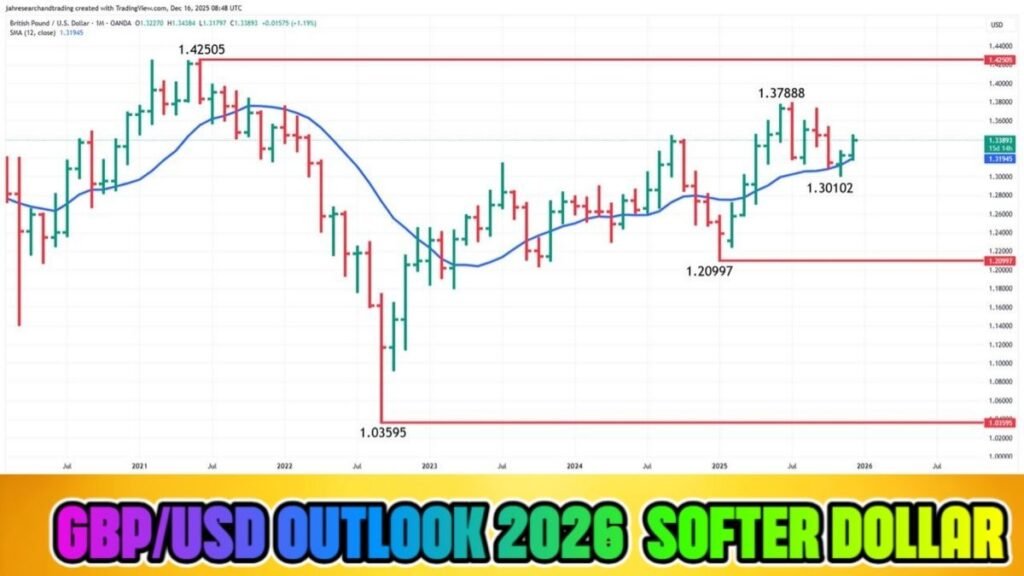
Positioning is already elevated following Sterling’s 2025 performance, leaving the pair vulnerable to pullbacks if momentum fades. A sustained break above 1.38 would likely require either a decisive US slowdown or a meaningful improvement in UK fundamentals.
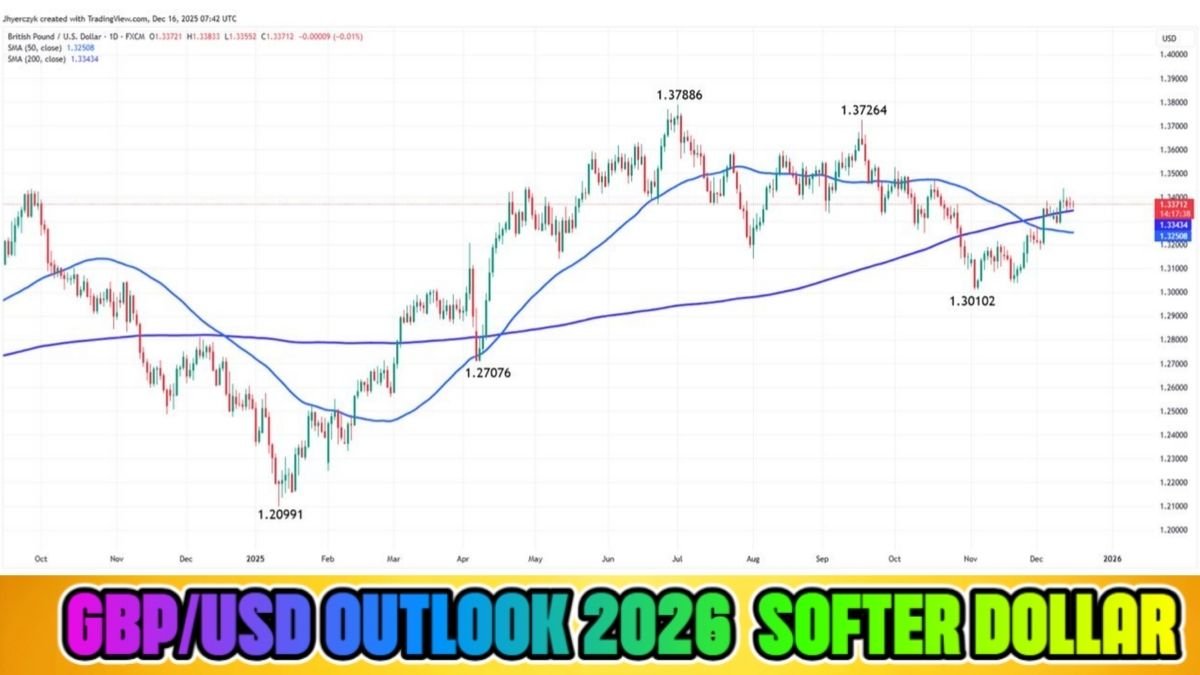
GBP/USD Technical Analysis (Daily Timeframe)
GBP/USD is showing early signs of momentum improvement but lacks confirmation.
The pair trades comfortably above the 50-day moving average (1.3250) and is attempting to establish support above the 200-day moving average (1.3343). However, the 50-day MA remains below the 200-day MA, signaling hesitation rather than a clean bullish setup.
The intermediate trend remains constructive. GBP/USD continues to move away from the 52-week average at 1.3165, maintaining a bullish structure that has survived multiple downside tests during 2025.
On the monthly chart, December’s close above the 12-month moving average (1.3194) sets a supportive tone for 2026. That said, the pair must still overcome major highs at 1.3789 and 1.4250 to confirm a long-term breakout. A sustained drop below 1.3010 would expose much deeper downside toward 1.2100.
ALSO READ: MCX Gold Support & Resistance Today | Live Price & Trend Analysis
Final Verdict: A Dollar-Driven Market with Sterling Limits
GBP/USD in 2026 is best understood as a dollar story constrained by UK realities.
The most likely path is modest gains in the first half of the year, supported by Fed easing, followed by consolidation or pullbacks as rate differentials narrow and fiscal risks re-emerge. A broad 1.30–1.38 year-end range remains the most defensible base case.
For traders and investors, flexibility matters more than conviction. Central bank messaging, labor data, and fiscal developments will dictate direction far more than technicals alone. The Fed’s pivot has provided direction—but not clarity.
FAQs – GBP/USD Forecast 2026
1. Is GBP/USD expected to rise in 2026?
GBP/USD has a mild upside bias in 2026, mainly driven by expectations of US dollar weakness as the Federal Reserve continues easing policy. However, gains are likely to be limited by weak UK growth and expected Bank of England rate cuts, making a strong sustained rally less likely.
2. What is the projected GBP/USD range for 2026?
Most major financial institutions forecast GBP/USD to trade within a broad 1.35 to 1.47 range during 2026. That said, consensus year-end expectations are more conservative, clustering closer to 1.36–1.40, reflecting persistent two-way volatility.
3. How will Federal Reserve policy impact GBP/USD in 2026?
Federal Reserve rate cuts reduce the US dollar’s yield advantage, which generally supports GBP/USD. If the Fed continues easing through mid-2026, the pair could trend higher. However, sticky US inflation could slow or pause cuts, limiting further upside.
4. Why is the Bank of England a constraint on Sterling strength?
The Bank of England is expected to cut interest rates further in 2026 due to weak economic growth and rising unemployment. These cuts reduce Sterling’s carry appeal, preventing GBP from fully benefiting even when the US dollar weakens.
5. What are the key technical levels to watch for GBP/USD?
On the upside, resistance is concentrated between 1.38 and 1.42, an area that has capped previous rallies. On the downside, 1.30–1.32 remains a strong support zone. A sustained break beyond either range would likely require a major shift in economic or policy conditions.
6. What are the main risks to the GBP/USD outlook in 2026?
The biggest risks include persistent US inflation delaying Fed rate cuts, worsening UK fiscal conditions, and global risk-off events that support the US dollar. Any of these factors could push GBP/USD toward the lower end of projected ranges.

Hi, I am the creator of MrTellMare.com—a passionate Stock Market learner and Technical Analysis enthusiast. My goal is to help traders understand Price Action, Market Structure, and Intraday Strategies in a simple and practical way. I share educational content on Equity, Index, Futures, Commodity and Crypto markets for informational and learning purposes only. I believe trading is a skill, and with the right knowledge and discipline, anyone can grow in financial markets.