
Ethereum Price Prediction has delivered one of its strongest comeback stories in recent years. After slipping to nearly $1,400 in April, ETH staged an aggressive recovery and surged to a new all-time high within four months, driven largely by major protocol upgrades and improving on-chain fundamentals.
The most important catalyst behind this revival was the Pectra upgrade, which significantly improved Ethereum’s scalability while sharply reducing transaction costs. This upgrade addressed long-standing concerns around network congestion and high gas fees, silencing many of Ethereum’s critics in the process.
Pectra Upgrade Strengthens Ethereum’s Core Fundamentals
Pectra introduced a higher number of blobs (data units) per block, making layer-2 solutions such as Base and Arbitrum far more efficient. As a result, transaction throughput improved and costs became more predictable — a crucial factor for developers and institutional users.
On-chain data from Etherscan confirms this shift. Since Pectra went live, transaction fee volatility has dropped considerably, allowing users to interact with smart contracts and transfer assets with far greater cost certainty compared to previous years.
Aside from a brief spike during the broader market sell-off on October 10, Ethereum’s average gas fees have remained relatively stable. This consistency marks a major step forward for the network’s usability.
Adding to this momentum, Ethereum successfully rolled out the Fusaka upgrade earlier this month. This additional enhancement further improves the network’s internal efficiency, reinforcing Ethereum’s position as a reliable foundation for decentralized applications and financial infrastructure.
ALSO READ: Ethereum ETH/US Support & Resistance Levels Today
Macro Uncertainty Triggers Heavy Selling Pressure
Despite hitting record highs in August, Ethereum soon faced aggressive selling. Much of this pressure came from global macro uncertainty, particularly surrounding renewed trade tensions after President Trump announced a sharp tariff escalation on China.
The unexpected policy move triggered record liquidation events across crypto markets, pushing traders into risk-off mode. Combined with uncertainty surrounding the Federal Reserve’s dot-plot outlook, the market had ample reasons to lock in profits near the top.
Ethereum Dominates DeFi and Real-World Assets Despite Competition
While competitors such as Solana (SOL), BNB Chain, and Sui (SUI) continue to grow, none have meaningfully challenged Ethereum’s dominance.
According to DeFi Llama, Ethereum still commands over 68% of the total DeFi market, with a total value locked (TVL) of approximately $68 billion. More than 75% of that value comes from flagship protocols like Aave and Lido, highlighting the depth of Ethereum’s ecosystem.
Ethereum also leads the real-world assets (RWA) sector, controlling roughly 66% market share with $12.3 billion in TVL. This trend points to increasing institutional adoption, especially as traditional financial firms explore blockchain-based settlement, tokenization, and yield strategies.
As Web3 adoption accelerates, Ethereum remains uniquely positioned to benefit from enterprise and institutional demand.
ALSO READ: Bitcoin (BTC/USD) Live Price, Support & Resistance Today | Intraday Trend Analysis
Technical Structure Suggests a 50% Risk of Drop Toward $1,650
Looking at the weekly chart, Ethereum’s technical structure raises important caution flags for 2026.
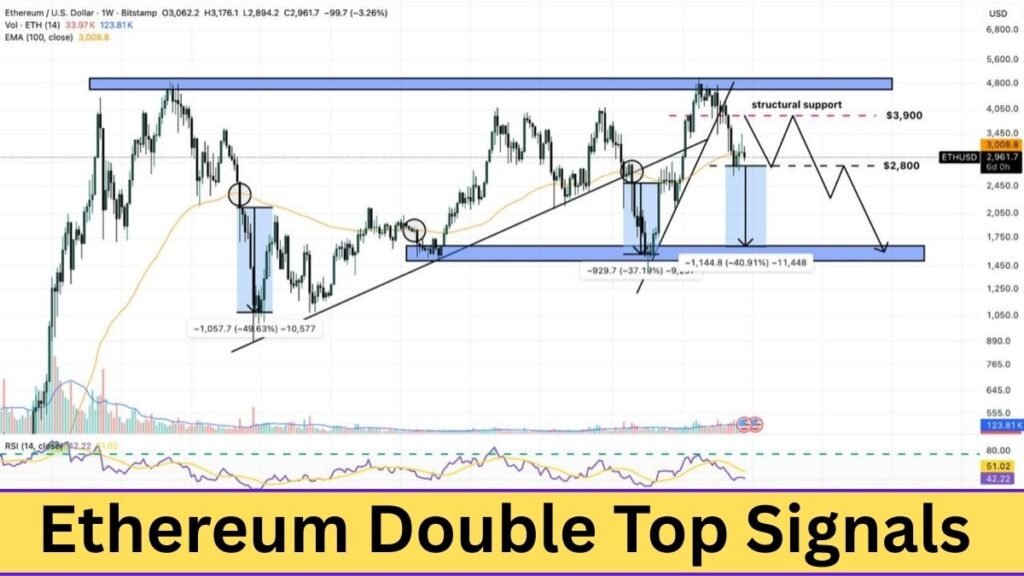
The most notable signal is a double-top pattern near $4,000, followed by a sharp decline. This pattern was confirmed when the Relative Strength Index (RSI) fell below its 14-week moving average — a classic sign of trend reversal.
Ethereum also broke two major trendline supports this year: first in February and again in late October. After the February breakdown, ETH eventually slid to the $1,400 zone, setting a precedent for deeper corrections following structural failures.
Currently, ETH has formed its first lower low, reinforcing the bearish market structure on higher time frames. A potential retest of the $3,900 resistance zone from below could act as a confirmation point.
If price action fails to reclaim this level, downside risks toward $2,500 — or even lower — increase significantly. The only scenario that would invalidate this bearish setup is a clean breakout above $4,000, which could open the door toward $5,000.
Another critical signal is ETH’s move below the 100-week exponential moving average (EMA). Since 2022, this has happened five times. In two of the previous four cases, Ethereum declined by more than 37%, statistically implying a 50% probability of a drop toward $1,650.
At present, no major negative catalyst supports such a severe decline — but the technical risk remains.
ALSO READ: Gold XAUUSD Price Today | Live Support Resistance & Intraday Analysis
Short-Term Outlook Turns Constructive for ETH
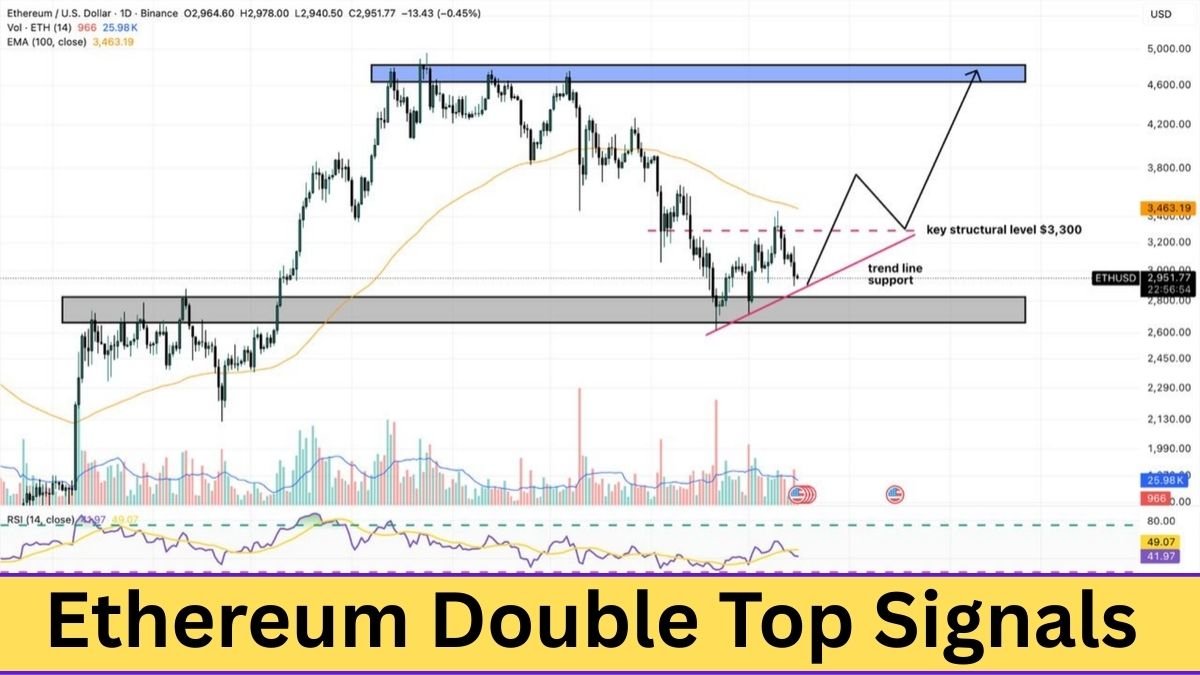
Zooming into the daily chart, early signs of a reversal are emerging. This supports the idea that Ethereum could attempt a recovery toward $3,900 in the medium term if bullish momentum strengthens.
Macro conditions are also improving. The Federal Reserve has cut interest rates for the third time this year, reducing uncertainty and improving risk appetite across financial markets.
Upcoming U.S. jobs and inflation data will be crucial. Strong readings could stabilize Ethereum’s price and encourage a broader crypto rebound while the Fed remains sidelined until next year.
Key Levels to Watch Going Forward
- Support: $2,850 (critical), followed by $2,800
- Resistance: $3,300, then $3,900
A breakdown below $2,800 would confirm the broader bearish thesis and expose ETH to a much deeper correction. On the other hand, a sustained move above $3,300 could validate the bullish recovery scenario and set the stage for a push toward $3,900 in 2026.
While strong resistance levels remain overhead, improving liquidity conditions and rising institutional adoption could quickly reverse sentiment through news-driven rallies.
ALSO READ: MCX Gold Support & Resistance Today | Live Price & Trend Analysis
Ethereum Price Prediction 2026 – FAQs
1. What is the Ethereum price prediction for 2026?
Ethereum’s price outlook for 2026 is mixed. While institutional adoption and network upgrades support long-term growth, technical indicators suggest a possible downside risk toward $1,650 if bearish momentum strengthens. A breakout above $4,000 would invalidate this bearish scenario.
2. Why is $1,650 an important downside level for Ethereum?
The $1,650 level is based on historical price behavior. In previous cycles, when Ethereum fell below the 100-week EMA, price corrections of over 35% followed. This makes $1,650 a statistically significant downside target if the bearish trend continues.
3. Is Ethereum still bullish despite recent price weakness?
In the short term, Ethereum shows early signs of stabilization, supported by improving macro conditions and rate cuts by the Federal Reserve. However, on higher time frames, ETH remains technically bearish unless it reclaims the $4,000 level.
4. How did the Pectra upgrade impact Ethereum?
The Pectra upgrade improved Ethereum’s scalability by increasing data blob capacity per block. This reduced transaction fee volatility and made layer-2 networks like Arbitrum and Base more efficient, improving overall network usability.
5. What role does the Fusaka upgrade play in Ethereum’s future?
The Fusaka upgrade further optimized Ethereum’s internal processes, improving reliability and performance. This strengthens Ethereum’s appeal for DeFi platforms, real-world asset tokenization, and enterprise blockchain adoption.
6. Can Ethereum still reach $5,000 after 2026?
Ethereum could target the $5,000 level if it successfully breaks and holds above $4,000. Such a move would invalidate the current bearish market structure and signal the start of a new bullish expansion phase.
7. How does Ethereum compare to Solana and other competitors?
Despite competition from Solana, BNB Chain, and others, Ethereum remains the dominant blockchain in DeFi and real-world assets, holding over 68% DeFi market share and leading institutional adoption.
8. What are the key support and resistance levels for ETH?
Key support levels for Ethereum are $2,850 and $2,800. Major resistance levels lie at $3,300 and $3,900. A breakdown below support could trigger a deeper correction.
9. How do macroeconomic factors affect Ethereum’s price?
Ethereum is sensitive to macro trends such as interest rate decisions, inflation data, and global trade policies. Rate cuts and easing financial conditions generally support ETH, while geopolitical tensions increase volatility.
10. Is Ethereum a good long-term investment for 2026?
Ethereum remains a strong long-term blockchain project due to its ecosystem dominance and continuous upgrades. However, price volatility remains high, and investors should manage risk carefully and avoid relying solely on short-term predictions.

Hi, I am the creator of MrTellMare.com—a passionate Stock Market learner and Technical Analysis enthusiast. My goal is to help traders understand Price Action, Market Structure, and Intraday Strategies in a simple and practical way. I share educational content on Equity, Index, Futures, Commodity and Crypto markets for informational and learning purposes only. I believe trading is a skill, and with the right knowledge and discipline, anyone can grow in financial markets.