
Last updated on May 10th, 2026 at 12:09 am
The Nasdaq Composite started the final trading sessions of the week on a cautious note, slipping below important technical support levels as selling pressure resurfaced across major technology stocks. After an early attempt to move higher, the tech-heavy index reversed course intraday, highlighting growing uncertainty among investors as market participants reassess valuations, sector leadership, and near-term momentum.
While losses remain relatively contained for now, the failure to sustain above critical moving averages has put the Nasdaq at a crossroads, with short-term direction likely to be decided by whether buyers can reclaim key levels before the close.
Nasdaq Composite Turns Lower After Early Strength
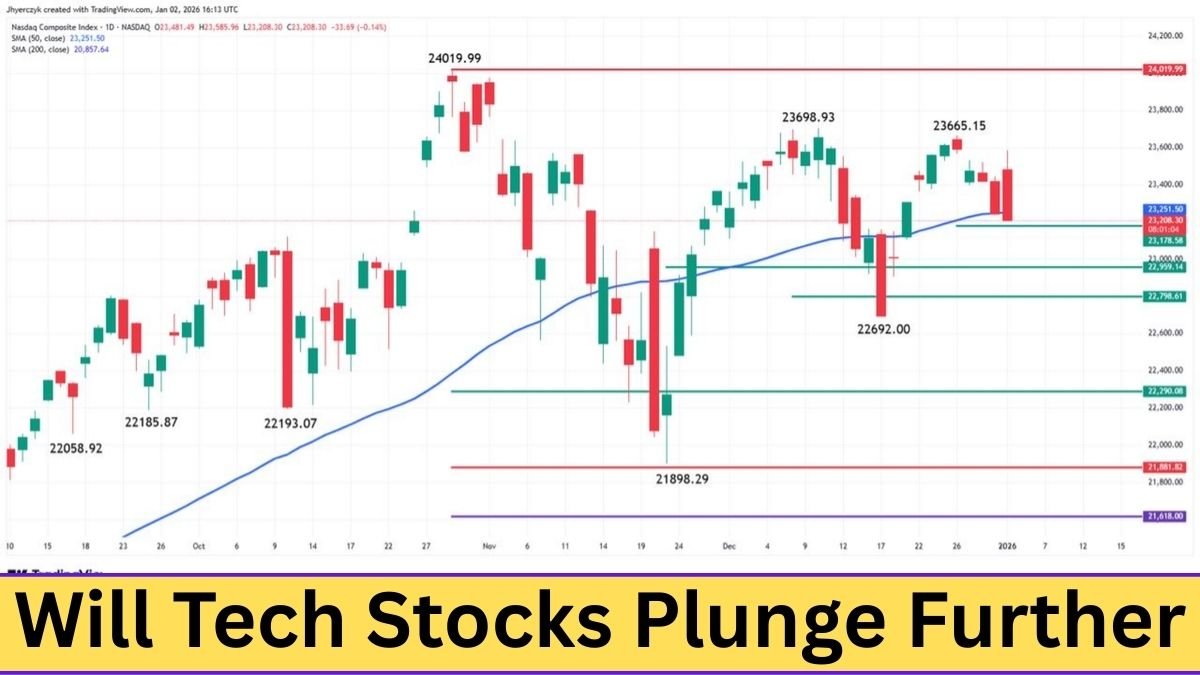
The Nasdaq Composite Index (IXIC) initially showed signs of stability during early trading, but those gains quickly faded. A bearish intraday reversal near 23,585 marked a turning point, pushing the index decisively lower.
Following this reversal, the Nasdaq fell below its 50-day moving average, a widely watched technical indicator often used to gauge short-term trend strength. The break of this level shifted momentum in favor of sellers and brought the index into a nearby technical pivot zone around 23,178.
Such intraday reversals often signal a change in short-term sentiment, particularly when they occur near resistance levels. For now, the Nasdaq’s inability to hold early gains suggests investors remain cautious toward high-growth technology stocks.
Why the 23,178 Level Is Now the Market’s Focus
From a technical standpoint, 23,178 has emerged as the most critical near-term level for the Nasdaq Composite. This zone represents a short-term pivot where buying and selling pressure may determine the index’s next directional move.
If the Nasdaq manages to stabilize above this level, it could prevent further downside and open the door to a recovery attempt later in the session. However, a decisive break below this pivot would likely increase selling momentum, exposing the index to deeper declines.
Below this area, the next downside targets are clustered between 22,960 and 22,800, a region that has previously acted as a demand zone. A failure there would leave the Nasdaq vulnerable to a test of the 22,692 swing low, which represents the last meaningful support before a broader technical breakdown.
ALSO READ: Is ETH Preparing for a Rally Toward $3,900? Key $2,800 Support Holds
Bullish Scenario: Recovery Above the 50-Day Moving Average
Despite the current weakness, bulls have not yet lost control entirely. For optimistic traders, the primary objective is a move back above the 50-day moving average, which sits just above the current price.
A recovery above this level would:
- Neutralize the intraday bearish reversal
- Restore short-term trend stability
- Improve the chances of a flat or unchanged close
Holding above the 23,178 pivot and reclaiming the moving average would signal that buyers are still willing to defend pullbacks, potentially setting the stage for renewed upside attempts in the coming sessions.
However, without strong volume or leadership from large-cap tech names, such a recovery may prove difficult.
Bearish Risk: Sustained Breakdown Could Extend Losses
The more concerning scenario for investors would be a sustained move below 23,178. If sellers gain confidence and push the index lower with conviction, losses could accelerate into the close and potentially spill over into the early part of next week.
In this case:
- Momentum traders may increase short exposure
- Algorithmic selling could intensify
- Volatility across tech stocks may rise
A breakdown below this level would reinforce the idea that the Nasdaq is undergoing a broader consolidation or corrective phase rather than a temporary pullback.
ALSO READ: Ethereum Price Prediction 2026: Double Top Signals Possible Drop Toward $1,650
Nasdaq Stock Movers: Sharp Divergence Beneath the Surface
Beneath the index-level weakness, individual stock performance across the Nasdaq has been sharply mixed, highlighting growing sector and stock-specific rotation.
Top Decliners Weighing on the Index
Several high-profile technology and software names are leading the downside:
- Applovin Corporation suffered steep losses, falling more than 8%
- Intuit, Workday, and Adobe each declined sharply as investors trimmed exposure to premium-valued software stocks
- Palantir Technologies also traded lower, reflecting reduced appetite for speculative growth names
The weakness in these stocks underscores investor caution toward companies with stretched valuations, particularly in an environment where earnings expectations are being scrutinized more closely.
Semiconductor Stocks Defy the Broader Weakness
In contrast, semiconductor stocks are emerging as a rare bright spot within the Nasdaq.
Notable gainers include:
- ASML Holding, which surged strongly and outperformed the broader market
- Micron Technology, Intel, Western Digital, and Marvell Technology, all posting solid gains
The strength in semiconductors suggests investors continue to see long-term value in companies tied to data centers, artificial intelligence infrastructure, and memory demand, even as broader tech sentiment remains mixed.
U.S. Stock Market Overview: Mixed Signals Across Major Indexes
The broader U.S. equity market is showing divergent performance rather than a unified trend.
- The Dow Jones Industrial Average is trading higher, supported by strength in industrial and value-oriented stocks
- The S&P 500 is hovering near flat, reflecting balanced buying and selling pressure
- The Nasdaq Composite remains modestly lower, weighed down by technology shares
This divergence highlights ongoing rotation rather than outright risk-off behavior, suggesting investors are selectively reallocating capital rather than exiting equities altogether.
Sector Performance Reveals Clear Rotation
Sector-level data further reinforces the idea that the market is rotating rather than collapsing.
Strongest Performing Sectors
- Industrials are leading gains, benefiting from infrastructure optimism and capital spending trends
- Utilities are attracting defensive inflows
- Energy continues to benefit from firm commodity prices
Weakest Performing Sectors
- Consumer Discretionary is under pressure, reflecting concerns about spending growth
- Communication Services is lagging due to weakness in media and internet stocks
- Financials are slightly lower, though losses remain limited
This pattern suggests investors are shifting toward defensive and value-oriented sectors, while reducing exposure to high-beta growth names.
Semiconductor Strength Offers a Silver Lining for Tech Bulls
One of the more encouraging developments for technology investors is the resilience of the semiconductor space.
Companies like Nvidia and Micron Technology continue to attract interest due to their exposure to artificial intelligence, data centers, and next-generation computing. These stocks delivered exceptional gains last year, and while returns may moderate, long-term demand trends remain intact.
If semiconductor leadership persists, it could help stabilize the Nasdaq and prevent a deeper correction, even if other tech segments continue to struggle.
ALSO READ: Bitcoin (BTC/USD) Live Price, Support & Resistance Today | Intraday Trend Analysis
2026 Market Outlook: Rotation Likely to Define the Year
Looking ahead, market strategists expect 2026 to be shaped by rotation rather than a single dominant theme.
Key expectations include:
- Continued shifting between tech and non-tech sectors
- Broader participation across the S&P 500
- Reduced concentration risk compared to previous years
While technology remains a cornerstone of market growth, investors are increasingly selective, favoring companies with strong balance sheets, clear earnings visibility, and sustainable cash flows.
Policy Developments Support Select Retail Stocks
Outside of technology, policy news is also influencing individual stock performance.
The postponement of planned tariff increases on select home goods products has provided a modest boost to retailers such as Wayfair and RH. While the impact on the broader market is limited, such developments illustrate how policy decisions can create short-term opportunities in specific industries.
What to Watch Into the Market Close
As trading progresses, investors will be watching closely to see whether:
- Technology stocks stabilize and recover
- The Nasdaq reclaims key technical levels
- Selling pressure intensifies into the close
Without a late-session rebound in major tech names, mixed performance is likely to persist. Volume levels remain lighter than average, which can exaggerate price movements and reduce reliability of intraday signals.
A clearer picture of market direction may emerge next week as participation returns to more normal levels.
ALSO READ: Dixon Support & Resistance Today Dixon Today Trend
Final Thoughts: Nasdaq at a Technical Crossroads
The Nasdaq Composite is currently navigating a delicate balance between consolidation and correction. While the index has slipped below key support levels, the broader market does not yet show signs of panic.
Key Takeaways:
- 23,178 remains the critical near-term support
- Recovery above the 50-day moving average could stabilize sentiment
- Semiconductor strength is offsetting weakness in software and growth stocks
- Sector rotation continues to shape market behavior
For now, patience and selectivity appear to be the dominant strategies as investors wait for clearer signals on whether technology stocks are preparing for a renewed advance — or a deeper reset.
Frequently Asked Questions (FAQs)
1. Why did the Nasdaq Composite fall below key support levels?
The Nasdaq Composite slipped lower after failing to hold early gains and breaking below its 50-day moving average. Weakness in major technology and software stocks triggered selling pressure, causing the index to move into a critical short-term pivot zone.
2. What is the most important support level for the Nasdaq right now?
The key near-term support level for the Nasdaq Composite is around 23,178. This pivot zone is crucial, as holding above it could stabilize the index, while a sustained break below may lead to further downside.
3. What could happen if the Nasdaq breaks below 23,178?
If the Nasdaq Composite falls decisively below 23,178, selling momentum could accelerate. In that scenario, the index may decline toward the 22,960–22,800 support zone, with the 22,692 swing low acting as the next major downside target.
4. Can the Nasdaq recover in the short term?
Yes, a short-term recovery is possible if buyers manage to defend the 23,178 level and push the index back above its 50-day moving average. Such a move would signal improving sentiment and reduce the risk of extended losses.
5. Why are semiconductor stocks outperforming the broader Nasdaq?
Semiconductor stocks are showing strength due to sustained demand linked to artificial intelligence, data centers, and advanced computing. Companies like ASML, Micron, and Nvidia continue to attract investor interest despite broader weakness in technology shares.
6. What does the mixed performance across U.S. stock indexes indicate?
The divergence between the Dow, S&P 500, and Nasdaq suggests sector rotation rather than a full market sell-off. Investors appear to be reallocating capital from high-growth tech stocks into industrials, energy, and defensive sectors.

Hi, I am the creator of MrTellMare.com—a passionate Stock Market learner and Technical Analysis enthusiast. My goal is to help traders understand Price Action, Market Structure, and Intraday Strategies in a simple and practical way. I share educational content on Equity, Index, Futures, Commodity and Crypto markets for informational and learning purposes only. I believe trading is a skill, and with the right knowledge and discipline, anyone can grow in financial markets.
Hello! This is my first visit to your blog! We are a team of volunteers and starting a new project in a community in the same niche. Your blog provided us useful information to work on. You have done a outstanding job!